In the world of Indian ecology, few names command as much respect—and controversy—as Dr. Madhav Gadgil. He is not your typical scientist who remains confined within the sterile walls of a laboratory. Instead, he has spent decades walking through the dense forests of the Western Ghats, listening to the indigenous communities, and fighting battles in the corridors of power to protect India’s natural heritage.
A Padma Bhushan awardee and the founder of the Centre for Ecological Sciences (CES) at IISc Bengaluru, Gadgil’s work is defined by a simple yet radical idea: Ecology is for the people.
The Philosophy: Science Meets Tradition
Madhav Gadgil’s approach to environmental science is unique because it bridges the gap between modern biological research and traditional ecological knowledge. In his influential books, such as This Fissured Land and Ecology Is for the People, he argues that you cannot save the environment by alienating the people who live in it.
He is a staunch advocate of decentralized environmental governance. Rather than a top-down “Delhi knows best” approach, Gadgil proposes that local communities—from village councils (Gram Sabhas) to tribal groups—should be the custodians of their forests. He believes that indigenous communities hold a “vernacular” understanding of nature that modern science often overlooks.
The Policy Masterstroke: The Gadgil Committee (WGEEP)
Gadgil’s most significant contribution to Indian policy came when he was appointed Chairman of the Western Ghats Ecology Expert Panel (WGEEP) in 2010. The Western Ghats are one of the world’s eight “hottest hotspots” of biological diversity, and they are also one of the most heavily populated biodiverse regions on Earth.
The Gadgil Report, officially submitted to the Ministry of Environment and Forests in 2011, was a masterpiece of scientific zoning. The report proposed classifying the Western Ghats into three zones based on their ecological sensitivity:
- ESZ 1 (Most Sensitive): Regions with high biodiversity and fragile ecosystems, where nearly all new developmental activities (like mining or large dams) would be banned.
- ESZ 2 (Highly Sensitive): Areas where development would be heavily regulated.
- ESZ 3 (Moderately Sensitive): Areas with some leeway for development, but with strict environmental oversight.
Key Policy Proposals:
- Authority: The report suggested establishing a Western Ghats Ecology Authority (WGEA) as a statutory body to oversee the implementation of these rules.
- Community Role: It mandated that Gram Sabhas (village councils) would have the final say in determining local ecological priorities.
- Ban on Specific Activities: It called for a gradual phase-out of mining, genetically modified crops, and specific polluting industries in the most sensitive zones.
The Great Debate: Gadgil vs. Kasturirangan
The Gadgil Report was welcomed by environmental scientists and activists. However, it faced fierce opposition from states like Kerala, Karnataka, and Goa. The mining lobby, real estate developers, and even local political groups argued that the report was “anti-development” and would displace farmers who lived in these regions.
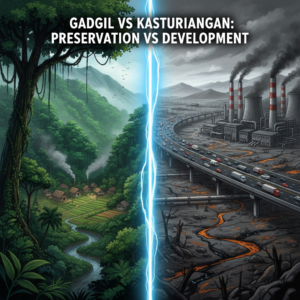
To quell the unrest, the government set up a High-Level Working Group (HLWG) headed by Dr. K. Kasturirangan, a space scientist.
This led to one of the most famous policy debates in Indian environmental history: Gadgil vs. Kasturirangan.
The Core Differences
| Feature | Gadgil Report (WGEEP) | Kasturirangan Report (HLWG) |
|---|---|---|
| Area Classification | Classified roughly 75% of the Western Ghats as ecologically sensitive. | Classified roughly 37% as ecologically sensitive. |
| Approach | Bottom-up: Focused on micro-level zoning and community management. | Top-down: Focused on a broader, satellite-image-based distinction. |
| Human Habitation | Treated human settlements as integral parts of the landscape that must adapt to ecological limits. | Distinguished between “cultural landscapes” (settlements/farms) and “natural landscapes,” putting less restriction on the former. |
| Industry | Called for a complete ban on new mining and polluting red-category industries in ESZ 1 & 2. | Allowed certain activities with regulation, focusing on banning mining only in the most sensitive “no-go” zones. |
The Conflict
Dr. Gadgil criticized the Kasturirangan report for being unscientific and too lenient. He argued that just because an area has human settlements (plantations or villages), it does not mean the ecology is intact or safe. He warned that the Kasturirangan approach would leave vast swathes of the Ghats vulnerable to the very destruction the panel was meant to prevent.
Kasturirangan supporters argued that his report was more “practical” and politically feasible, aiming to balance conservation with the immediate economic needs of the population.
Why Gadgil’s Vision Still Matters
While the Kasturirangan report has largely been the framework used by state governments for notifications, the spirit of the Gadgil Report remains the gold standard for conservationists.
In recent years, as Kerala and Karnataka have faced devastating landslides, floods, and water crises, many have pointed back to Gadgil’s warnings. He had argued that unchecked quarrying, deforestation for plantations, and illegal construction in the “sensitive” zones would lead to exactly these disasters.
A Note on Gadgil’s Policy Legacy
If one were to draft a policy note based on Gadgil’s ethos today, it would look something like this:
Subject: Integrating Ecological Democracy into Development Planning
1. Objective: To transition from a “License Raj” in environmental clearance to an “Ecological Democracy.”
2. Framework:
- Decentralization: Shift the power of environmental decision-making to local bodies (Gram Sabhas and Ward Sabhas).
- Incentivization: Instead of solely banning activities, provide “Payment for Ecosystem Services” (PES) to communities that protect watersheds and forests.
- Transparency: All environmental impact assessments (EIA) must be publicly available in local languages, not just technical English jargon.
3. The “Gadgil Principle”: Development cannot be measured solely by GDP growth. It must be measured by the health of the ecosystem that sustains the economy.
Conclusion
Madhav Gadgil remains a towering figure because he refused to separate science from society. He taught us that the Western Ghats are not just a collection of trees and animals; they are a life-support system for millions of people.
While politicians and developers may have found the Gadgil Report inconvenient, science has time and again proven that nature’s laws are negotiable only at our own peril. As India grapples with the climate crisis, the wisdom of Madhav Gadgil—that ecology must be for the people, by the people—has never been more relevant.