

India’s forests are often celebrated for their green cover, but what truly keeps them alive is something far less visible—biodiversity. From the towering sal and teak trees of central India to the dense rainforests of the Western Ghats and the fragile mangroves of the Sundarbans, forests thrive not because of trees alone, but because of the intricate web of life they support. As human pressures intensify, this web is slowly unraveling. The loss of biodiversity is no longer a distant environmental concern—it is a direct threat to forest health, climate stability, and the livelihoods of millions who depend on forests for survival.
When we think of forests, trees usually dominate our imagination. But forests are much more than tree cover. They are complex living systems where plants, insects, birds, animals, fungi, and microorganisms interact in delicate balance. This richness of life—known as biodiversity—is the foundation of healthy and resilient forests. In a country like India, one of the world’s mega-biodiverse nations, forest biodiversity is not just an ecological asset; it is a national lifeline.
Biodiversity operates at three interconnected levels: genetic diversity, species diversity, and ecosystem diversity. Each level plays a crucial role in keeping forests functional and resilient.
Genetic diversity refers to variations within a species. In Indian forests, genetic diversity allows tree species such as sal, teak, bamboo, and wild fruit trees to survive under diverse climatic conditions—from drought-prone regions of central India to the high-rainfall zones of the Northeast. This variation helps forests adapt to changing temperatures, erratic rainfall, pests, and diseases. However, excessive dependence on monoculture plantations or limited genetic stock reduces this natural resilience, making forests more vulnerable to climate stress.
Species diversity is the variety of plants and animals living together in a forest. India’s forests host an extraordinary range of life—from orchids and medicinal plants in the Western Ghats to insects, birds, and large mammals such as elephants and tigers. Each species performs a specific role. Insects pollinate plants, birds and mammals disperse seeds, predators regulate populations, and decomposers recycle nutrients. When species disappear, these interactions weaken, leading to poor regeneration and declining forest health.
Ecosystem diversity reflects the variety of forest types across the country. India is home to tropical evergreen forests, dry deciduous forests, mangroves, alpine forests, and mangrove ecosystems like the Sundarbans, which protect coastal regions from cyclones and sea-level rise. The Western Ghats, a global biodiversity hotspot, regulate water flow for peninsular rivers, while Himalayan forests influence rainfall patterns and prevent soil erosion. Losing any one of these ecosystems means losing unique ecological functions that cannot be replaced.
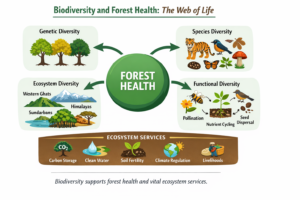

Forest health depends on the collective efforts of many life forms. Plants provide structure and energy through photosynthesis. Soil microbes silently sustain forests by decomposing organic matter and improving soil fertility. Insects, often overlooked, are essential for pollination and nutrient cycling. Birds and mammals support forest regeneration by dispersing seeds across landscapes. The decline of even one group can disrupt the entire system.
What makes forests truly resilient is functional diversity—the variety of roles played by different species. When multiple species perform similar functions in different ways, forests gain a built-in safety mechanism. If one species is lost, others can partially compensate. This functional diversity allows forests to recover from fires, pest outbreaks, and extreme weather events.
Healthy, biodiverse forests provide vital ecosystem services—carbon storage, clean water, fertile soils, climate regulation, and livelihoods for millions of forest-dependent communities in India. As biodiversity declines, forests become weaker, less productive, and more prone to collapse.
In essence, biodiversity is the invisible force that keeps Indian forests alive. Protecting it is not just about conservation—it is about ensuring ecological stability, climate resilience, and sustainable development for the future.
How Human Activities Are Driving Biodiversity Loss in India’s Forests
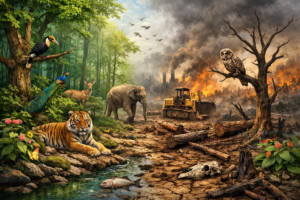
Across India, forests are under increasing pressure—not from natural forces alone, but from human activities that are reshaping landscapes faster than ecosystems can adapt. While India has made commitments to increase forest cover, the quality of forests and their biodiversity is steadily declining. This silent erosion is weakening forest health and reducing their ability to support life.
One of the most significant drivers of biodiversity loss is deforestation and habitat fragmentation. Large tracts of forests have been cleared or broken into smaller patches due to mining, dams, highways, railways, and urban expansion. In central India, infrastructure projects have fragmented critical wildlife corridors, disrupting the movement of species such as elephants and tigers. Fragmented forests isolate plant and animal populations, reduce genetic diversity, and make species more vulnerable to extinction.
Another major concern is the growing reliance on monoculture plantations. While tree plantations are often counted as “forest cover,” they lack the biodiversity of natural forests. In several parts of India, diverse native forests have been replaced by single-species plantations of eucalyptus, teak, or acacia. These plantations support fewer insects, birds, and soil organisms, leading to simplified ecosystems that are more prone to pests, diseases, and water stress. The loss of undergrowth and native species further reduces forest regeneration and soil health.
Mining and industrial activities have caused severe biodiversity loss in ecologically sensitive regions. In the Eastern Ghats and parts of Odisha and Chhattisgarh, open-cast mining has led to large-scale forest destruction, soil degradation, and water pollution. These activities not only remove vegetation but also permanently alter landforms, making natural recovery extremely difficult. Forest-dependent communities often lose access to food, medicinal plants, and livelihoods, adding a social dimension to biodiversity loss.
Invasive alien species introduced intentionally or accidentally are another growing threat. Plants such as Lantana camara and Prosopis juliflora have spread aggressively across Indian forests, especially in dry and deciduous regions. These invasive species outcompete native plants, reduce fodder availability for wildlife, and hinder forest regeneration. Over time, they change soil properties and fire regimes, further degrading forest ecosystems.
Climate change is intensifying these pressures. Rising temperatures, erratic rainfall, and prolonged droughts are altering forest phenology—the timing of flowering, fruiting, and seed germination. In the Western Ghats, changes in rainfall patterns are affecting endemic plant species and pollinators. In the Himalayan region, warming temperatures are pushing species to higher altitudes, shrinking available habitats and increasing the risk of local extinctions.
Overexploitation of forest resources also contributes to biodiversity decline. Unsustainable harvesting of fuelwood, timber, medicinal plants, and non-timber forest products puts pressure on regeneration. In some regions, commercially valuable species are selectively removed, disturbing ecological balance and reducing species diversity over time.
The combined effect of these human activities is a gradual weakening of forest ecosystems. Forests become less resilient to pests, fires, and extreme weather events. Their ability to store carbon, regulate water, and support biodiversity declines. What remains may look green from afar, but ecologically, such forests are increasingly fragile.
India’s experience highlights a critical lesson: protecting forest area alone is not enough. Without safeguarding biodiversity, forests lose their strength and purpose. Addressing human-driven biodiversity loss requires moving beyond short-term gains toward long-term ecological thinking—where conservation, development, and livelihoods are balanced.


