When we think of medicinal plants, herbs, and roots usually come to mind. Rarely do we pause to notice lichens—those humble, slow-growing organisms clinging to rocks, trees, and soil. Yet, hidden within these resilient life forms lies a powerful story of healing, nutrition, and cultural heritage. In recent years, scientific research has rekindled global interest in lichens, revealing their immense potential in pharmaceutics and medicine.
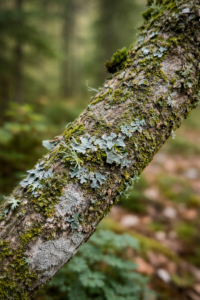
Lichens are unique symbiotic organisms formed by a partnership between fungi and algae (or cyanobacteria). This remarkable alliance enables them to survive in some of the harshest environments on Earth—from Arctic tundras to high mountain ranges. Across centuries, human communities living in these regions learned to harness lichens not only as food but also as medicine.
A Global Legacy of Healing
Traditional medicinal uses of lichens have been documented across Asia, Europe, Africa, and the Americas. In the Nepal Himalaya, seven lichen species belonging to families such as Parmeliaceae, Physciaceae, Ramalinaceae, and Usneaceae have long been used for medicinal purposes. Genera like Usnea, Parmotrema, Ramalina, and Thamnolia are especially valued in local healing traditions.
Similarly, in China, lichens such as Lobaria, Peltigera, and Usnea have been used to treat skin infections and digestive disorders. Indigenous communities in the USA traditionally relied on Usnea, Cladonia, and Cladina, while European folk medicine prominently features Cetraria, Peltigera, and Lobaria. In Africa, species like Usnea and Parmotrema are recognized for their antifungal, digestive, and anti-inflammatory properties.
Interestingly, while lichens are almost universally used across cultures, Australia shows limited documented medicinal use, highlighting how traditional knowledge can vary dramatically across continents.
Chharila: India’s Incredible Lichen Mix
One of the most fascinating examples of lichen use in India is Chharila, also known as stone flower. This traditional medicinal powder is typically prepared from edible lichens of the Parmeliaceae family, especially Parmotrema perlatum and P. nilgherrense. Occasionally, species of Usnea are also added to the mix.
Once confined to indigenous medicine, Chharila has now entered mainstream markets. Pharmaceutical companies are promoting it as a health supplement, while chefs value it as a spice for its distinctive aroma. Scientifically, stone flower is rich in proteins, glucose, phenols, and vitamins A and C, making it nutritionally significant. Medicinally, it exhibits astringent, sedative, and diuretic properties, and has been traditionally used to manage bronchitis, inflammation, arthritis, vomiting, and even toothache.
Lichens have emerged as important bioresources at the intersection of traditional knowledge, nutrition, and modern food systems. Among them, Parmotrema perlatum, commonly known as black stone flower, kalpasi, or dagad phool, occupies a unique position as both a culinary spice and a nutritionally significant organism. Widely used across southern and western India and throughout the Himalayan belt, this edible lichen is valued for the distinctive earthy, smoky, and umami-rich aroma it releases when heated in oil or ghee, making it an essential component of several regional masala blends. In Tamil Nadu, it is a signature ingredient of Chettinad cuisine, particularly in biryanis and meat-based gravies, while in Maharashtra it forms a key component of Goda Masala and Kala Masala. It is also integral to Hyderabadi cuisine in Telangana and Andhra Pradesh, and is traditionally harvested and consumed in Himalayan regions such as Uttarakhand, Assam, Sikkim, and Arunachal Pradesh by indigenous communities. Tribal groups in central India, including the Baiga, Bhil, and Gond, further diversify its culinary use by incorporating related lichen species into local dishes.
Beyond its culinary relevance, edible lichens hold increasing importance as rare vegan sources of vitamin D, a nutrient largely absent from plant-based diets. Certain lichens naturally synthesize vitamin D₂ and vitamin D₃ due to their exposure to ultraviolet radiation and their unique algal–fungal symbiotic metabolism. This characteristic makes lichens particularly valuable in vegetarian and vegan nutrition, especially in regions with limited sunlight exposure or low dietary diversity. Unlike fortified foods, lichens represent a natural, non-animal-derived source of vitamin D, aligning with sustainable and plant-forward dietary practices. In addition to vitamin D, Parmotrema species are known to contain phenolic compounds, carbohydrates, and other bioactive constituents that contribute to their functional food potential. As interest grows in sustainable nutrition and plant-based micronutrient sources, lichens such as Parmotrema perlatum are gaining renewed attention not only as traditional spices but also as nutritionally significant organisms capable of addressing hidden hunger in plant-based populations.
Phytochemical Composition of Lichens: Nature’s Chemical Factory
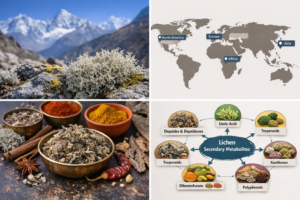
ichens synthesize an extraordinary array of secondary metabolites, accounting for nearly 20% of their dry weight. These include depsides, depsidones, xanthones, quinones, dibenzofurans, terpenoids, steroids, carotenoids, and phenolic compounds.
Uniquely produced through algal–fungal symbiosis, these metabolites exhibit antibacterial, antifungal, antiviral, anticancer, antidiabetic, neuroprotective, wound-healing, and photoprotective properties.
Ancient Wisdom Meets Modern Science
As taxonomy advances and new lichen species continue to be discovered, scientists face the challenge of matching traditional names with modern classifications. Yet, this only adds to the excitement. Lichens were once considered sacred, used in rituals for spiritual and physical healing. Today, they are being rediscovered as living libraries of bioactive compounds.
In an era searching for sustainable and novel drug sources, lichens stand as a reminder that nature’s smallest survivors may hold some of the biggest solutions.